
This post contains affiliate links. As an Amazon Associate I earn from qualifying purchases.
Indoor herb garden ideas for winter work best when the growing conditions lead the design. A bright windowsill, a slim wall setup, or a small grow-light station can all hold useful kitchen herbs, but no container can replace enough light or good drainage. These nine real creator-made setups show different ways to organize pots, not guaranteed winter harvests. Choose the spot with the best light first, then borrow the container arrangement that fits your space and watering routine.
Before you pick: Most culinary herbs need strong light; a dim kitchen corner is not a growing location just because it looks tidy. Keep drainage holes in the actual growing pots, empty catch trays, and separate herbs with different watering needs. “Edible for people” does not automatically mean safe for pets.
1. Individual Herb Pots along a Wide Windowsill
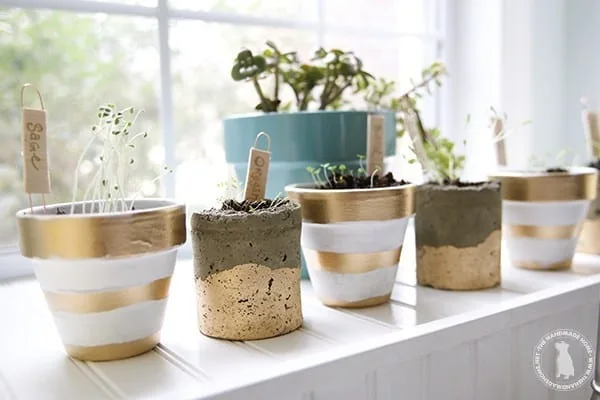
A line of individual pots makes good use of this wide kitchen sill without joining every herb into one root zone. Each container can be lifted out for watering, turned toward the light, or replaced when a plant finishes. The different pot sizes also make it easier to give larger herbs more root space. For a simple winter windowsill herb garden, this is a flexible starting point rather than an all-or-nothing installation.
Quick facts: Indoor growing · Strong window light or supplemental light · Easy to rearrange
Small-space tip: Keep pots away from cold glass and leave room to open the window safely. Use a water-catching tray, but empty it after draining so the plants do not stand in water.
Get the look: a similar container potting mix for individually potted herbs.
2. A Deep Wall Frame with an Overhead Grow Light
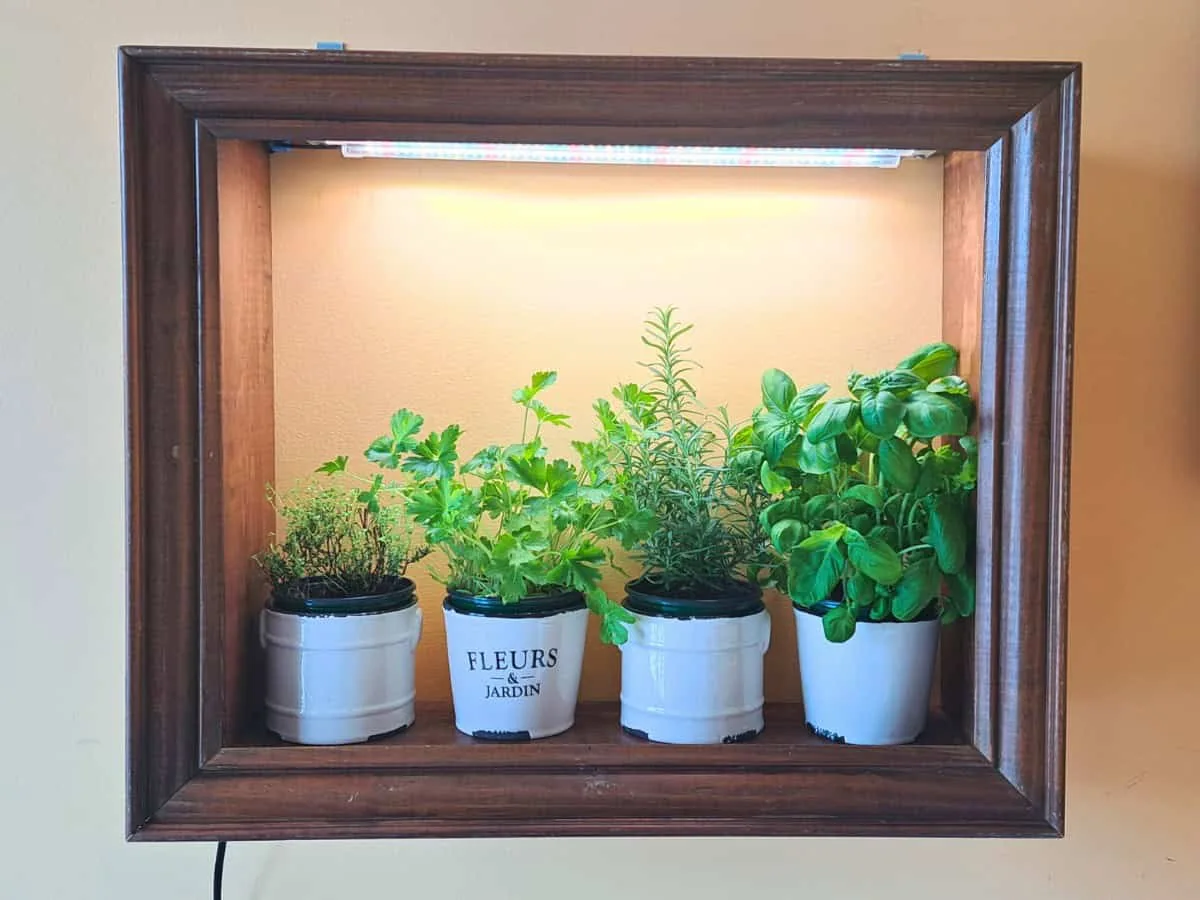
Small herb pots sit inside a deep wooden frame, with a light above the leaves rather than somewhere across the room. The frame gives the pots a dedicated station and keeps them together for checks and watering. This is a useful indoor herb garden idea when winter window light is insufficient, provided the light reaches the growing tips evenly. The exact fixture in the creator’s project is not identified here.
Quick facts: Artificial-light setup · Timer and suitable fixture distance · Moderate installation
Care tip: University of Minnesota Extension suggests about 12 hours of artificial light daily for indoor herbs; seedlings may need more. Adjust fixture distance to the maker’s guidance and keep foliage from touching hot or electrical parts.
Get the look: similar grow-light bars, not the exact photographed fixture.
3. One Vertical Column of Hanging Pots beside a Window
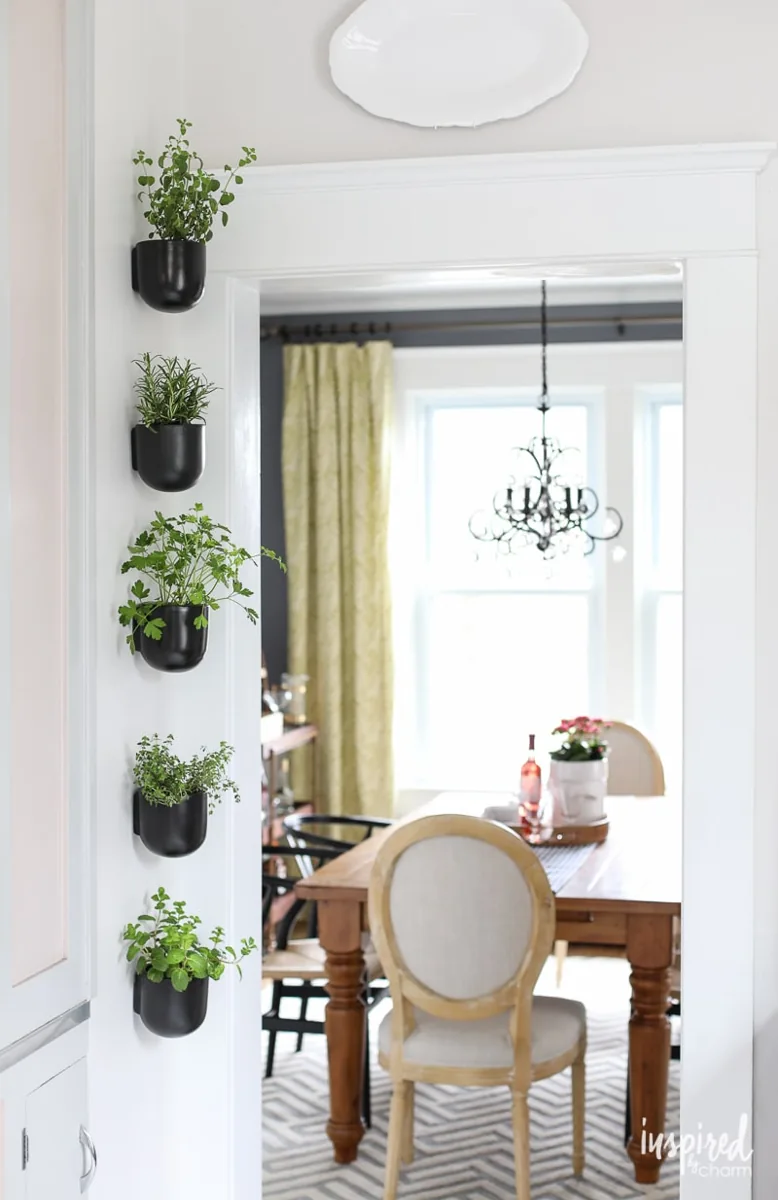
A narrow column of dark hanging pots uses the strip of wall beside this kitchen window. It frees the counter while keeping each herb in its own container. The important gardening limit is light: a pot beside a window may get less useful light than one directly in front of the glass, and the lower pots may be shaded. Choose this arrangement only if you can verify suitable light at each level.
Quick facts: Individual hanging pots · Check light at every level · Moderate mounting
Renter-friendly: Use approved hardware and get permission before drilling. Lift each growing pot out to water and drain it safely; the photo does not establish that a decorative outer pot has drainage or that the wall is protected from drips.
4. A Labeled Wooden Herb Trough for the Counter
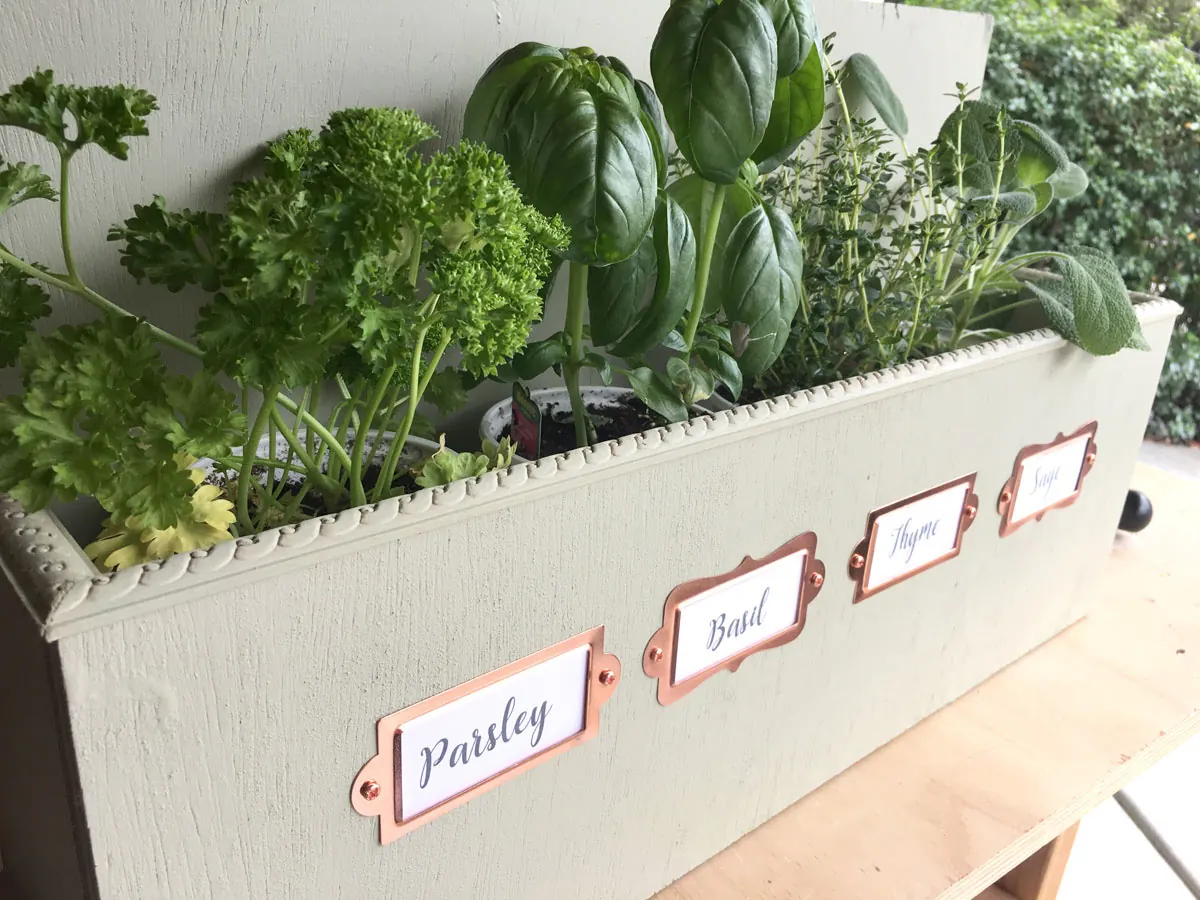
A wooden trough groups several herbs in one compact footprint, with labels making the plants easy to find. The box can be an organizer for separate pots rather than one shared watering zone, which is useful when you cook with several different herbs. Keep it near suitable natural or artificial light, not permanently under a dark cabinet. It is a practical kitchen herb setup when you want one unit to move for cleaning.
Quick facts: Grouped herbs · Match individual light and water needs · Moderate care
Plant swap: Do not force moisture-loving parsley and drier-growing rosemary onto one watering schedule. Use removable draining pots inside the box if you want different herbs together visually while keeping their root zones separate.
Get the look: similar plant labels for keeping different herbs easy to identify.
5. Reused Tea Tins with Removable Growing Pots
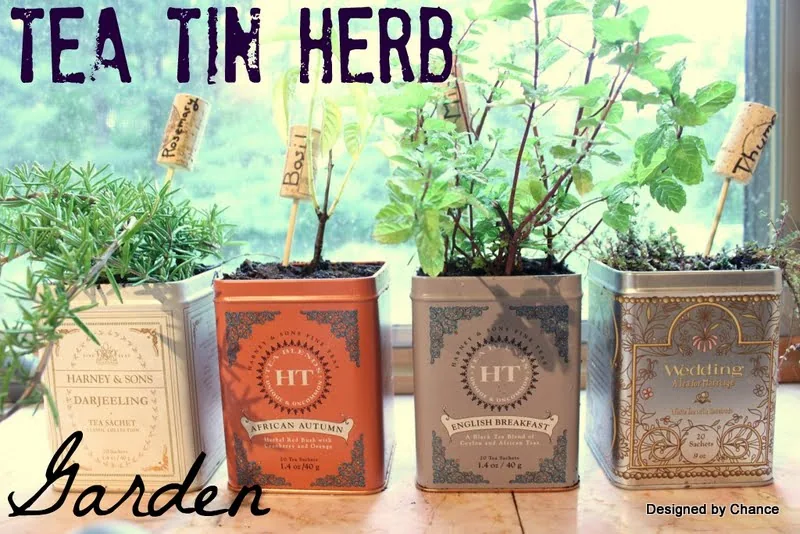
Tea tins turn a few small herbs into a compact row along a bright sill. The straight sides fit close together, which is useful where a broad terracotta saucer would take up more room. Keep the gardening part simple: the tin can serve as an outer cover around a draining nursery pot. These are ordinary container herbs, not a self-watering system or a guarantee that small pots will stay productive indefinitely.
Quick facts: Small reused containers · Removable drainage insert recommended · Easy project
DIY level: Check tins for rust and sharp edges. Lift the growing pot out to water, let it drain, and empty any water left in the cover. A layer of pebbles does not turn a closed tin into a drained planter.
6. A Cutting-Board Stand That Holds Two Herb Pots
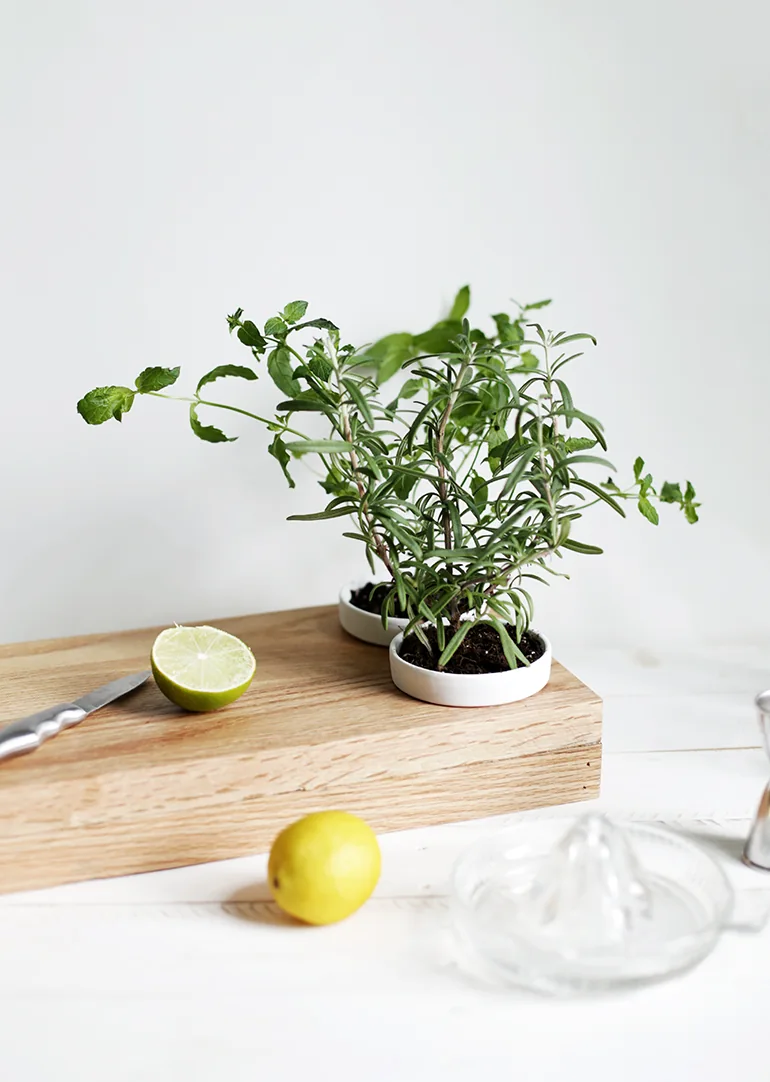
Two small pots fit into this thick wooden stand, keeping a pair of herbs together without making them share soil. It is a compact arrangement for a kitchen with a suitable bright growing spot nearby. The wood is a holder, not a reason to let water collect around the pots. Use it as a plant station and keep potting mix and drainage water away from food-preparation surfaces.
Quick facts: Two separate root zones · Bright light needed · Easy daily access
Make it last: Remove the pots for watering and let them drain before returning them. Take modest, clean harvests from healthy growth rather than cutting a small winter plant back hard to fill a recipe.
Get the look: similar herb scissors for small harvests; not the knife shown in the photo.
7. Two Wall Rails for a Larger Herb Station
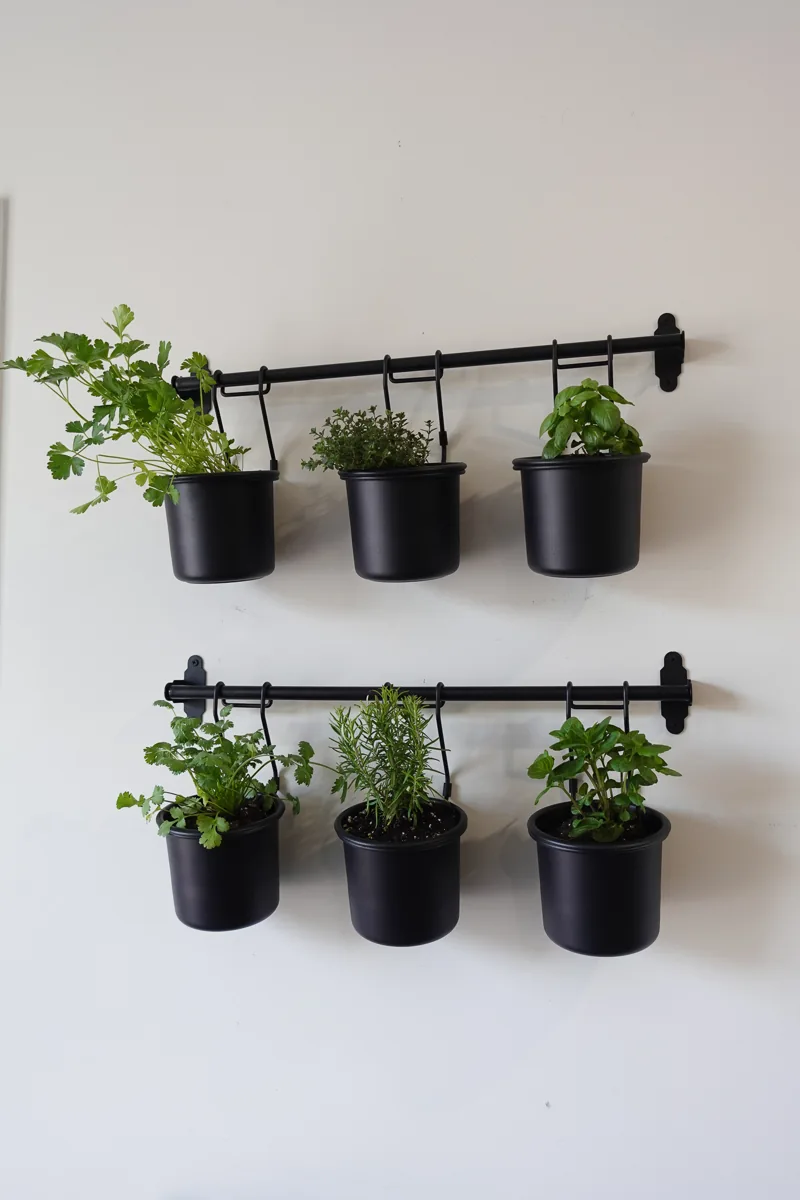
Two rails support a wider collection of individual hanging pots on this wall. The arrangement gives each plant its own position, which helps with labeling and selective watering. It also creates a clear responsibility: every pot still needs adequate light, including those shaded by the upper row. Before making a permanent wall installation, test the intended growing position with a few plants or plan properly positioned supplemental lighting.
Quick facts: Two-level herb station · Avoid self-shading · Moderate installation
Budget note: Start with fewer pots than the rails can hold. More empty space can improve access and light distribution, and it is easier to add plants later than rescue a crowded collection that cannot get enough winter light.
8. Hanging Bowls for Separate Herbs in a Bright Spot
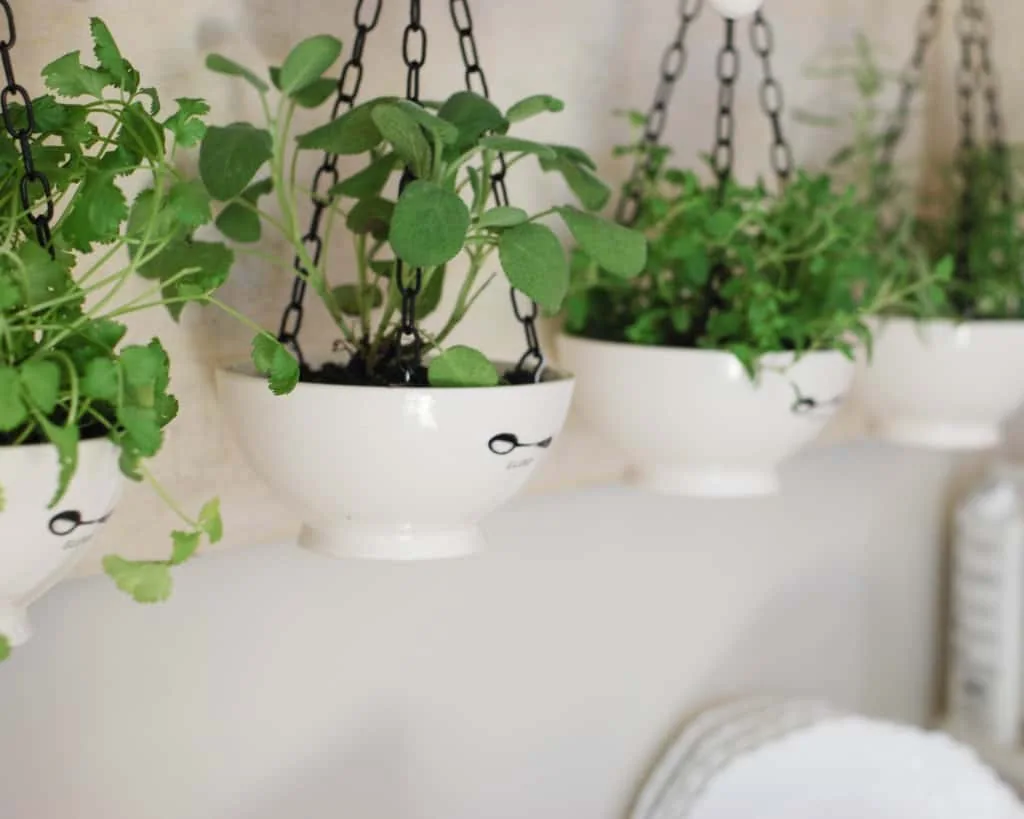
White bowls hang at slightly different heights, keeping small herbs together while leaving the counter clear. The soft foliage is the focus, but the care plan matters more than the bowl shape. Use a removable draining pot inside any bowl that lacks an outlet, and choose secure, suitable supports. Keep herbs with different moisture needs in separate inserts rather than treating the whole hanging group as one planted container.
Quick facts: Individual hanging containers · Drain after watering · Check mounting load
Pet note: Do not assume culinary herbs are pet-safe. Chives and other alliums are toxic to cats and dogs, and some other herbs can cause problems if chewed; identify every plant and place the setup where pets cannot browse or pull it down.
9. A Rolling, Tiered Herb Shelf with Room to Grow
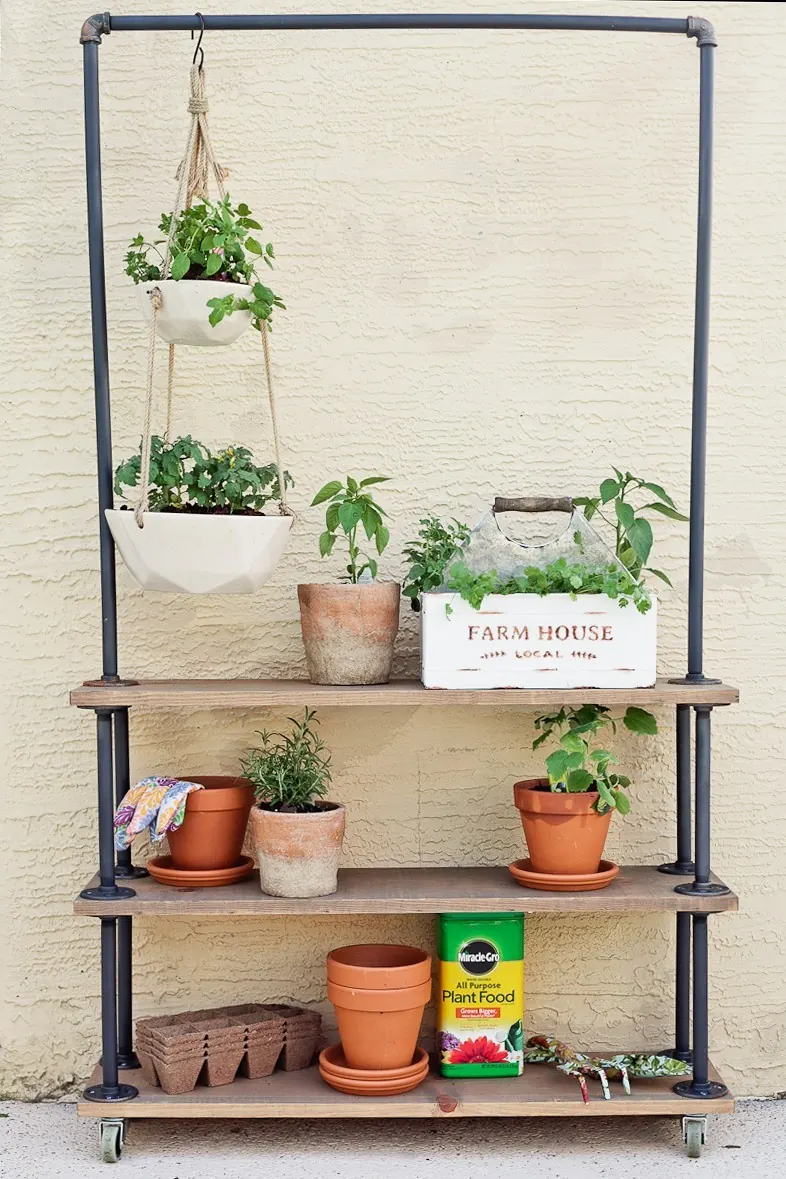
A wood-and-pipe shelf puts herb pots and hanging baskets on several levels above casters. The useful feature is mobility: you can move the whole unit for cleaning or place it in a genuinely bright growing spot instead of filling a fixed dark corner. A shelf photographed against a wall is a layout reference, not evidence of adequate winter light. Keep heavy pots low and make sure upper shelves do not block light to the plants below.
Quick facts: Mobile multi-level setup · Light every growing level · Moderate DIY effort
Best season: Use winter to establish a manageable number of herbs under reliable light. Park the unit securely rather than chasing the sun around the room, and check that its casters, shelf joints, and any grow-light fittings suit the finished load.
Shop the Look: Winter Indoor Herb Supplies
A suitable grow light, small harvesting scissors, a set of plant labels, and container mix support several of these setups. They are similar growing supplies, not the creators’ exact products. Choose supplies for your own plants and space rather than copying a photograph’s scale.

- 6000K White Light - equipped with 10 Red + 74 White LEDs, this growing Lamp is similar to the full-spectrum sunlight at noon,that is professionally designed for indoor garden plants.Moreover, its color rendering index is as high as 95, the light is soft and flicker-free, which is very suitable for reading lamp
- Upgraded Remote with Timer & Dimmable Setting - the remote attached to cord is easy to operate with 3 timer settings of 4Hrs, 8Hrs, or 12Hrs.Once activated, the timer automatically repeats the selected ON and OFF cycle every 24 hours, without manual intervention. You also have full control over the intensity with dimmable options (50%/100%) to suit your plants' precise needs.
- Easy to Install - with flexible Gooseneck & strong clamp,it allows you to place the growth light in any direction to provide the best lighting angle for your plants,meet the cover around the shelf/desk multiple pot plants.
- High Efficiency LED Lamp - as for LED power draw this seedling lights just comsume about 10 w and is equivalent to a 50 watts Halogen Bulb.Estimately monthly cost roughly $2 in electricity (12 hours a day). It is a great gift if you growing some small house plants.
- 【365 Days Warrantty】GooingTop service team offer 365 days warrantty and 24h friendly customer service. If there are ever any issues about the product, please feel fre e to contac t us and we will send you a new replacement.

- GARDENING ESSENTIAL: With these stainless steel blade gardening shears, pruning tasks like cutting flower stems or maintaining your herb garden are easier with fast and clean cuts
- MAXIMUM POWER AND PRECISION: Micro-tip blades on these garden clippers (handheld) cut all the way to the tip for clean, healthy cuts making these great plant pruning shears
- LONG-LASTING AND RELIABLE: Stainless steel blades stay sharp through heavy use and provide excellent durability for lasting value; Fiskars garden pruners and tools are built to last
- QUALITY GARDEN TOOLS: Designed to help you cultivate a better garden, Fiskars hand pruners are equipped with smart technologies and award-winning, ergonomic features that make it easier and more enjoyable to transform your outdoor space
- INCLUDES: (1) Pair of 6" Fiskars Micro-Tip Pruning Shears with Sheath; Lifetime Warranty


- Material: These vegetable garden markers are made from 100% natural bamboo, plant bamboo label is durable, does not pollute the soil, will not cause harm to the earth, and is environmentally friendly and renewable.
- Easy to Write: The surface of the plant label is smooth, and the marker is very easy to write on it, and please don’t worry at all about the ink in the plant tags wash off in the rain.
- Product Size: Bamboo Plant Label approx 3.9 inch in length, 2.4 inch in width, they are T-type designs that provide you with a lot of space to name your plants, record dates, mark types, etc.
- Great for Gardener: These plant markers can be widely used in gardens, fruit trees, seedlings, flowers, plants, vegetables, potted plants and so on. The use of labels will not have any impact on plants.
- Value Package: Our package includes 75 pieces of plant labels and 1 marking pen, sufficient quantity can be used for gardens, classroom projects, greenhouses, commercial gardens, kindergartens handmade craft DIY, etc.

- FOR USE ON: Not just an indoor potting soil, this can also be used as a potting soil for outdoor plants and is a great soil mix for vegetables, herbs & all other container plants & flowers.
- CONTAINS: This organic soil for plants & vegetables is a rich blend of sphagnum peat moss, humus & perlite enriched with earthworm castings, alfalfa meal, kelp meal & feather meal
- MYCO-TONE: A proprietary blend of endo & ecto mycorrhizae.
- WHEN TO USE: Any time planting containers, whether starting a new plant or transplanting into a larger container. Plants require regular re-potting and fresh planting soil for optimum growth.
- ORGANIC GARDENING: Contains a rich blend of only the finest natural ingredients. No synthetic plant foods or chemicals are used.
Which Indoor Herb Setup Fits Your Kitchen?
Choose by light and access before deciding whether pots belong on a sill, a wall, or a shelf.
| Your situation | Ideas to try | What to solve first |
|---|---|---|
| A wide, bright sill | 1 or 5 | Drainage, cold glass, and room for mature roots. |
| Weak winter daylight | 2 | An appropriate grow light and safe electrical setup. |
| Very little counter space | 3, 7, or 8 | Light at each level and secure mounting. |
| A movable kitchen plant station | 4, 6, or 9 | An actual bright growing position, not just convenient storage. |
Measure Light Where the Leaves Will Be
Most culinary herbs need at least six hours of direct sunlight or suitable supplemental light. In winter, windows can provide much less than that, especially behind neighboring buildings or deep overhangs. Check the exact place each pot will sit instead of judging the brightness of the room. University of Minnesota Extension’s herb-growing guidance is a useful starting point for light, drainage, and indoor care.
Group by Watering Needs, Not Just Appearance
Separate growing pots make a mixed collection easier to manage. Parsley and cilantro generally need more consistent moisture than woody herbs such as rosemary and thyme, so do not water every container merely because one is dry. Check the mix below the surface; the Minnesota guidance uses dryness about half an inch down as a useful indoor-herb check. Water as needed and drain well rather than following a fixed weekly calendar.
Plan for Small Harvests and Safe Access
Winter light can limit growth, so begin with a few herbs you use often and take small amounts while the plants remain healthy. Avoid placing pots above hot appliances or where children and animals can pull them down. For pet-accessible rooms, check the exact names in a reliable toxicity resource; the ASPCA’s chives entry explains why a familiar kitchen herb can still be unsuitable for pets to chew.
Start with two or three herbs in a spot where you can actually meet their needs. A small, well-lit collection is a better winter kitchen garden than a larger arrangement that only looks good on installation day.
Featured photo: 📷 Stephanie at Celebrated Nest.