
This post contains affiliate links. As an Amazon Associate I earn from qualifying purchases.
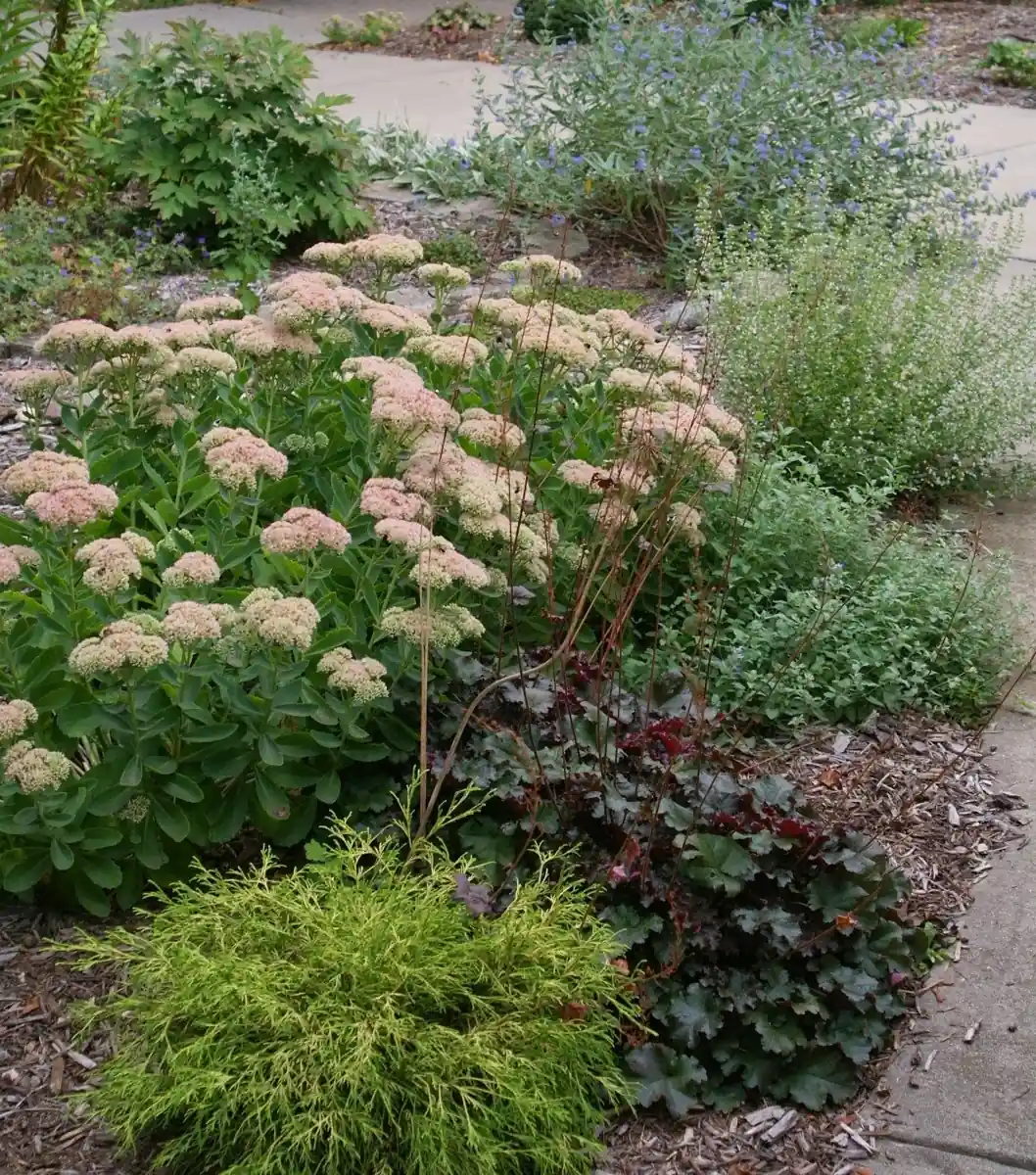
Evergreen shrubs for small gardens need to earn their space long after the nursery pot is gone. This shortlist mixes blue-needled juniper, genuinely slow-growing conifers, and broadleaf choices for suitable acidic soil. Blue Star juniper and Slowmound pine suit sunny positions; Debutante pieris offers a different look in a sheltered spot.
Use winter to compare labels and measure the bed, then plant when local conditions allow. None of these is a one-size-fits-all foundation shrub, and “dwarf” does not mean it stops growing.
How we chose: These are six named selections identified in their creators’ photographs, chosen for lasting foliage and a manageable role in a smaller garden. Zones are conservative in-ground guidance, not container ratings; check the exact cultivar locally. The leucothoe needs a broad bed, not a tiny planting pocket.
1. Blue Star Juniper (Juniperus squamata ‘Blue Star’)
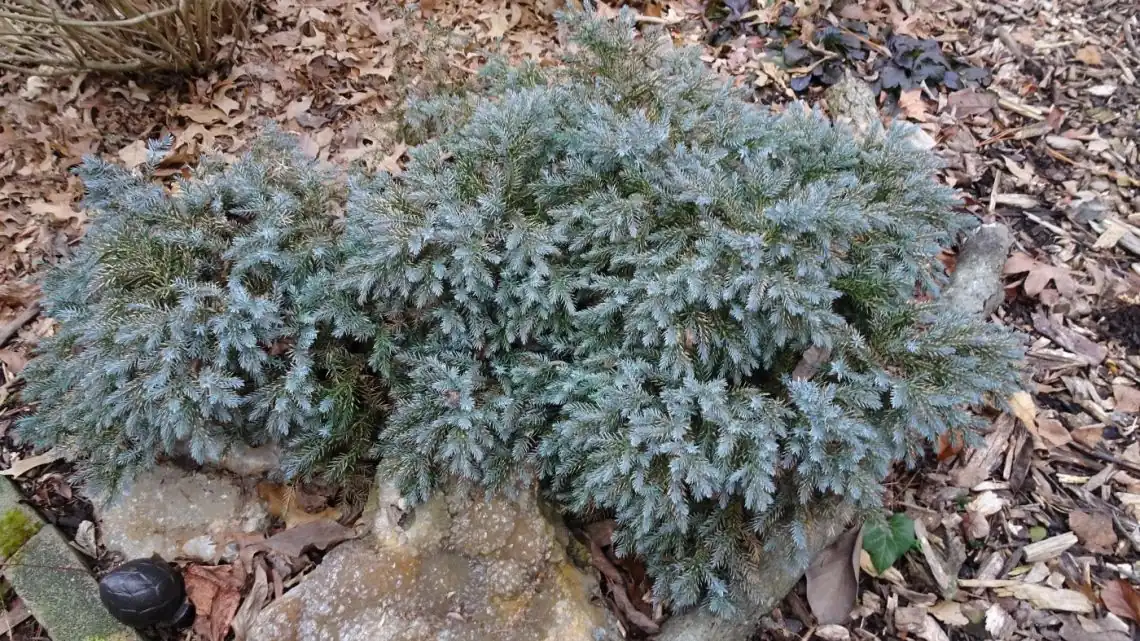
Zones: 4–8 · Light: Full sun · Size: About 1–3 ft tall × 1–4 ft wide · Interest: Blue-gray evergreen needles · Pets: Check; no pet-safe claim verified
Jo Batzer’s plant shows the dense, rounded blue foliage that makes this juniper useful beside warmer-colored paving or a simple green border. It is a distinct shrub, not a seasonal blue accent that needs replacing after winter. Give it its own footprint rather than treating the young nursery plant as gap filler.
The named cultivar matters: an unlabeled juniper may have a very different habit. Avoid a persistently wet hollow, and leave its natural outline visible instead of clipping it into a tight cube.
Care tip: Good drainage matters more than extra feeding. A hand trowel for checking the planting area is useful for small exploratory holes, but a larger root ball needs an appropriately sized planting hole.
2. Green Velvet Boxwood (Buxus ‘Green Velvet’)
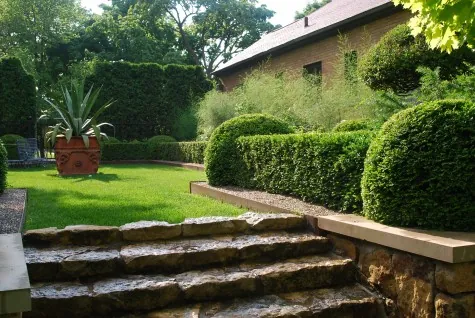
Zones: 5–8 · Light: Sun to part shade · Size: NC State lists about 2–3 ft tall and wide; check local mature-size guidance · Interest: Dense green evergreen foliage · Pets: Toxic if eaten
Deborah Silver identifies Green Velvet in this established planting around garden steps. Its fine texture suits a low framework where a broad, informal conifer would feel too loose. Treat the photograph as a design example, not evidence that every plant will stay at an identical height.
This is a clipped-garden choice with ongoing care, not a maintenance-free alternative to a fence. Ask about boxwood disease pressure in your region before committing an entire small garden to one species.
Winter note: Do not reshape a hedge just because a mild January day feels inviting. Follow local pruning timing, and use bypass pruners for selective cuts rather than assuming every plant needs repeated close shearing.
3. Slowmound Mugo Pine (Pinus mugo ‘Slowmound’)
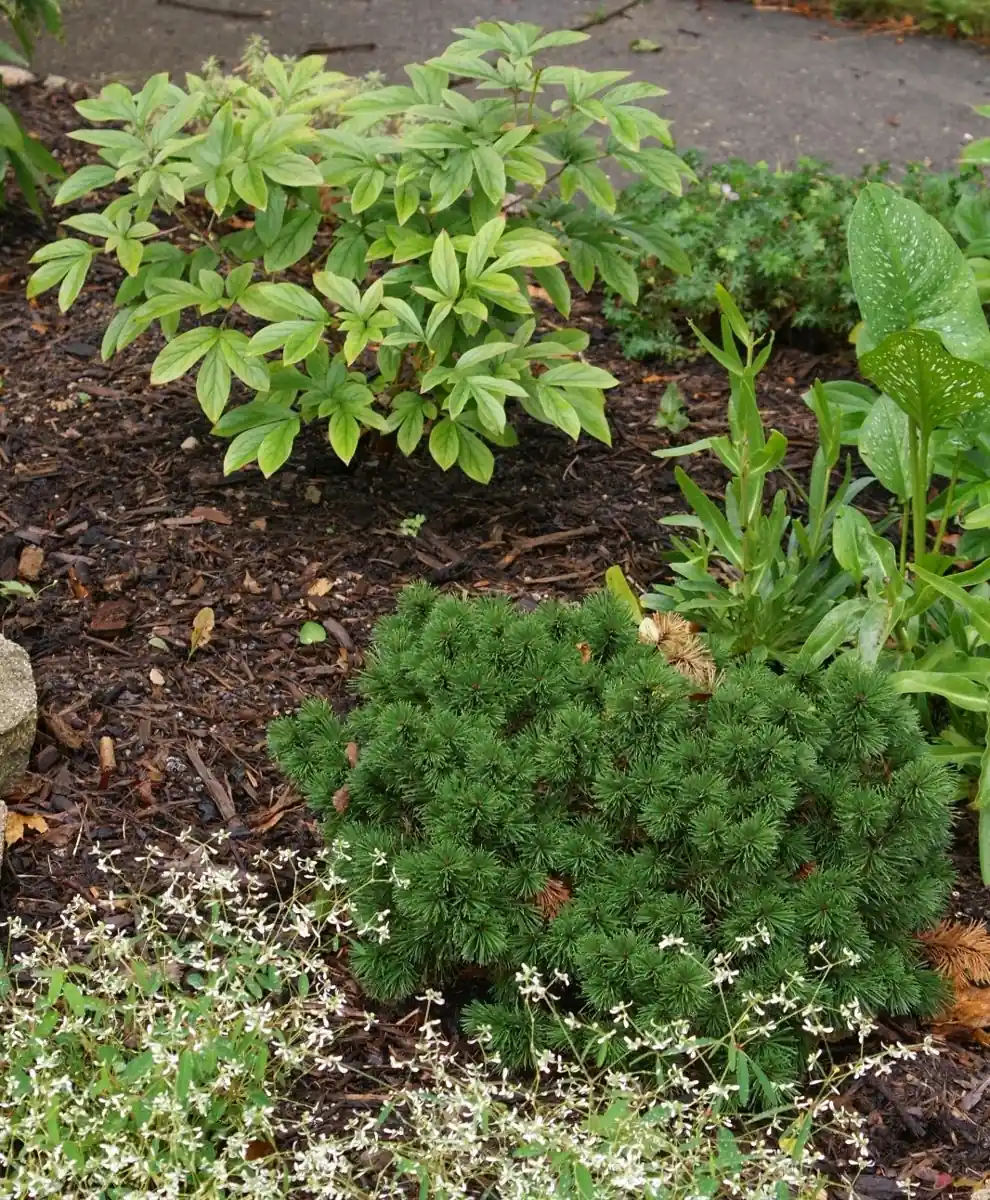
Zones: 3–7, conservatively · Light: Full sun · Size: About 1–2 ft tall and wide at 10 years; continues growing · Interest: Dark evergreen needles and rounded form · Pets: Check; no pet-safe claim verified
This rounded pine is specifically labelled Slowmound in the creator’s mixed border. Its restrained growth is the reason to seek the cultivar rather than buying any plant sold simply as mugo pine: the species can become much larger. The American Conifer Society describes a dense mound about one to two feet across at ten years.
That is a time-based estimate, not an ultimate size guarantee. It is a useful low anchor where you want needles rather than broad leaves and have a sunny, well-drained position.
Budget note: Buy for the named plant, not the biggest pot on the bench. Use a compact measuring tape to compare the ten-year footprint with the bed before paying for a more mature specimen.
4. Debutante Pieris (Pieris japonica ‘Debutante’)
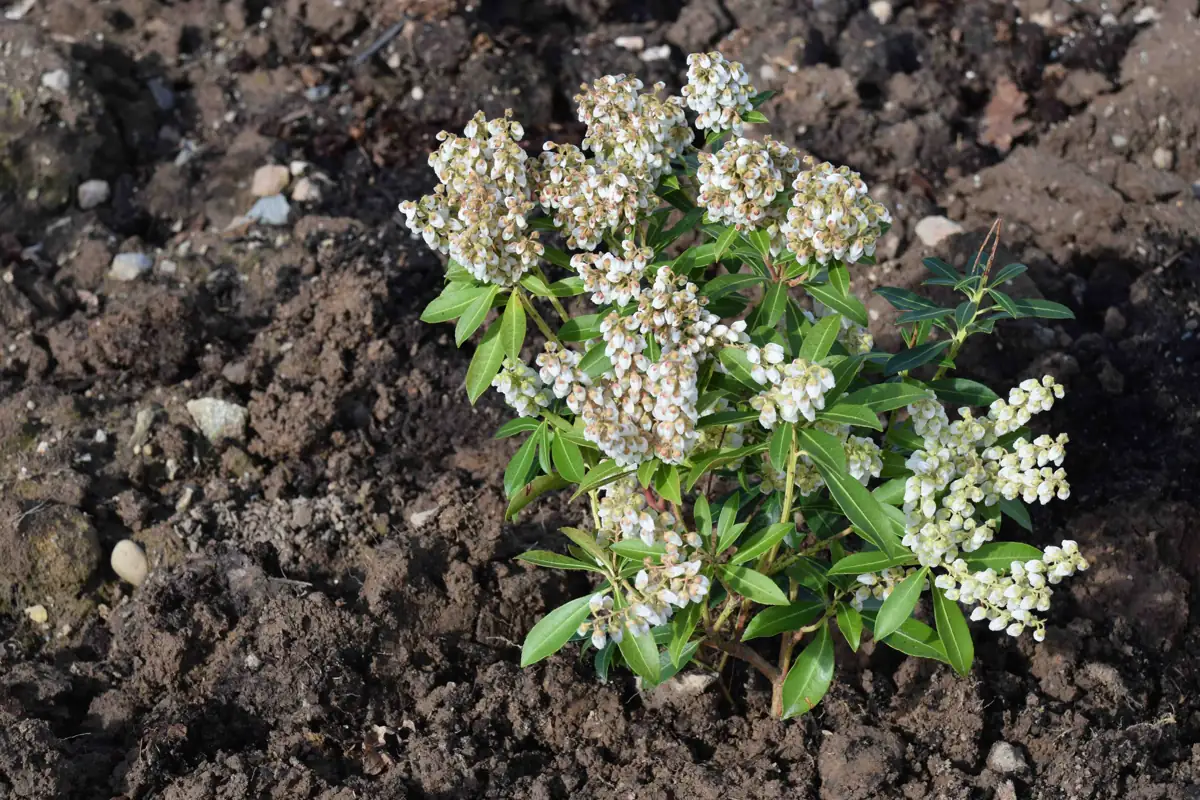
Zones: Typically 5–8; confirm cultivar locally · Light: Sun to part shade, sheltered · Size: About 1½–3 ft tall and wide · Interest: Evergreen leaves and spring white flowers · Pets: Toxic if eaten
Geoff Stebbings identifies this white-flowered plant as Debutante, a smaller pieris than the full-size species. The drooping flower clusters add a second season of interest, but the evergreen foliage is why it belongs in a winter planning list. A sheltered acidic bed is the right starting point; it is not a sensible fix for alkaline soil beside fresh concrete.
Choose it because the site fits, not because you hope fertilizer will turn an unsuitable location into the woodland-like conditions it prefers.
Plant with: Group it with plants that also need acidic, moist but well-drained soil. Avoid a sun-baked, drying corner and keep fallen leaves and cut stems away from pets.
5. Loowit Japanese Hemlock (Tsuga diversifolia ‘Loowit’)
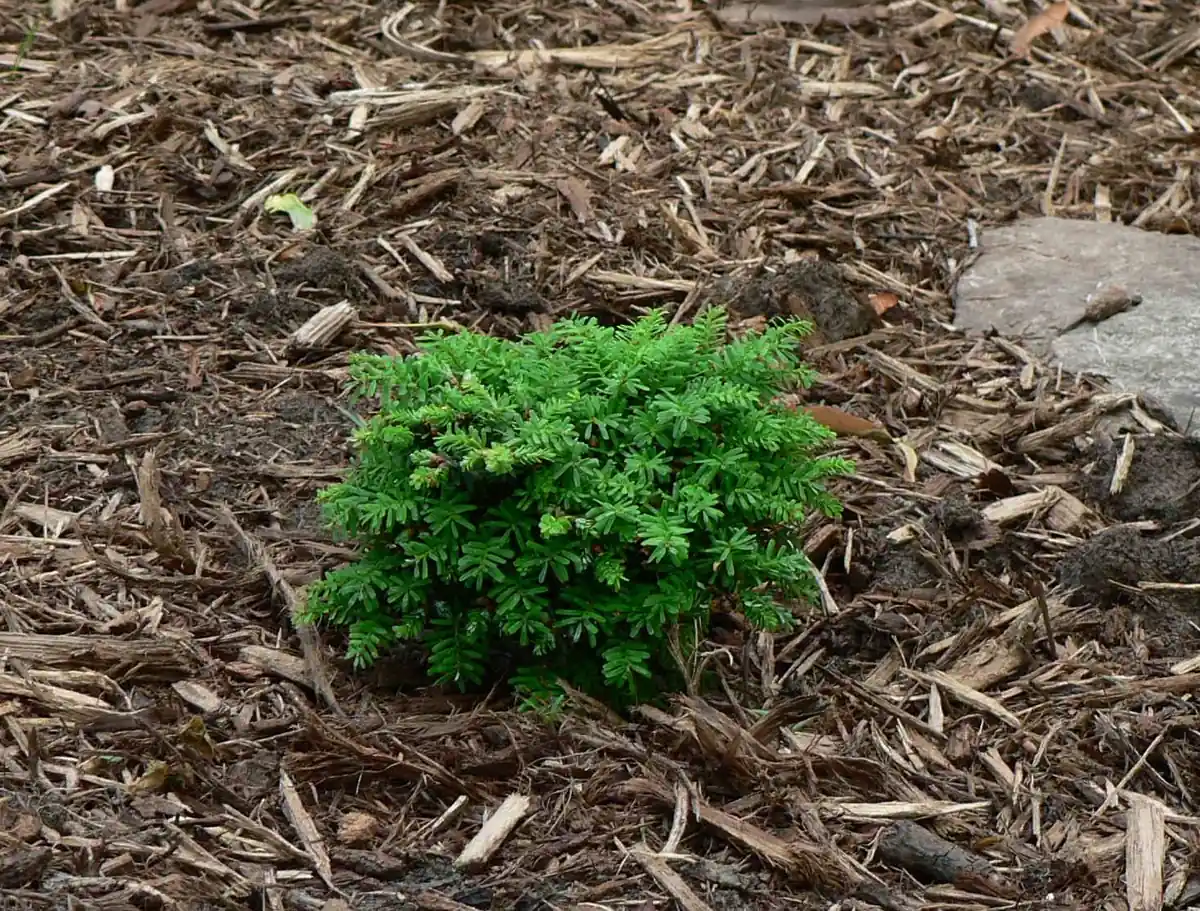
Zones: 4–7 · Light: Sun to part shade · Size: About 18 in. tall in Chicago Botanic Garden guidance; confirm spread locally · Interest: Low, dense evergreen needles · Pets: Check; no pet-safe claim verified
This is Japanese hemlock, specifically Tsuga diversifolia Loowit—not a compact Canadian hemlock with a similar-sounding label. The creator’s photograph shows the low, cushioned habit that suits the front of a mixed bed. Chicago Botanic Garden lists an eighteen-inch height and moderate moisture needs, making it a useful candidate where a taller evergreen would dominate the view.
Width still matters, so ask for the expected spread of the plant you are buying. Leave its naturally layered texture visible rather than trying to make it imitate boxwood.
Care tip: Do not place a moisture-loving small conifer in a dry foundation strip and expect its size to solve the site mismatch. Check soil moisture during establishment and follow local planting advice.
6. Girard’s Rainbow Leucothoe (Leucothoe fontanesiana ‘Girard’s Rainbow’)
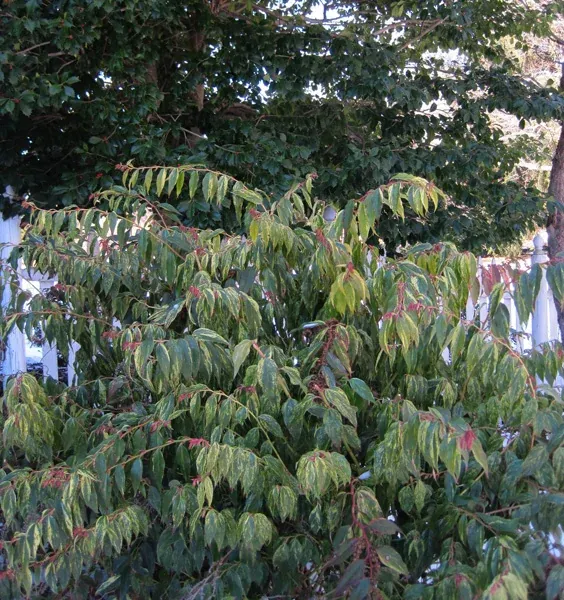
Zones: 5–6 on this conservative shortlist; verify cultivar locally · Light: Part to dappled shade · Size: Allow for the species range, 2–6 ft tall × 4–8 ft wide, unless a verified cultivar label specifies less · Interest: Variegated evergreen foliage · Pets: Toxic if eaten
Jana Milbocker identifies her arching, variegated plant as Girard’s Rainbow. It offers a looser, brighter-leaved counterpoint to clipped shrubs, particularly in an acidic, shaded border. This is the roomy-bed option in the list, not a miniature: do not tuck it into a two-foot gap beside the front steps.
NC State’s species guidance gives a broad potential spread, so use a locally verified cultivar size before planting. In a very small garden, one generous foliage feature may be more useful than several shrubs that quickly crowd each other.
Container note: This shortlist is for in-ground planting. Do not transfer an in-ground hardiness rating straight to an exposed pot. If you cannot provide enough bed width and acidic, moisture-retentive soil, skip this plant rather than trying to prune away the mismatch.
Compare the Six Evergreen Shrubs
These are in-ground planning ranges. A question mark about pet safety is not a reassurance that a plant is edible or harmless.
| Plant | Conservative zones | Light | Planning size | Pets |
|---|---|---|---|---|
| Blue Star juniper | 4–8 | Full sun | 1–3 ft high; 1–4 ft wide | Check |
| Green Velvet boxwood | 5–8 | Sun–part shade | 2–3 ft; check local mature label | Toxic if eaten |
| Slowmound pine | 3–7 | Full sun | 1–2 ft at 10 years; grows on | Check |
| Debutante pieris | 5–8; confirm locally | Sun–part shade, sheltered | 1½–3 ft high and wide | Toxic if eaten |
| Loowit Japanese hemlock | 4–7 | Sun–part shade | About 18 in. high; verify width | Check |
| Girard’s Rainbow leucothoe | 5–6; confirm locally | Part–dappled shade | Species allowance: 2–6 × 4–8 ft | Toxic if eaten |
What You’ll Need for a Small Evergreen Bed
Measure first and match the plant to the site. These are supporting tools, not products identified in the photographs: a trowel, tape, hand pruners, and a soil thermometer for checking planting conditions when the seasonal transition is uncertain. A temperature reading alone does not mean wet or frozen ground is ready to dig.

- Clean, Precision Bypass Cutting up to 1” Diameter – Sharp, forged steel bypass blade delivers smooth, scissor-like cuts through live branches, stems, and green wood up to 1 inch thick, helping reduce plant damage and promote faster, healthier regrowth.
- Heavy-Duty Forged Steel Construction – Built from high-quality forged steel for superior strength and long-lasting durability, making these professional pruning shears ideal for daily use in gardening, landscaping, orchards, and vineyard maintenance.
- Ergonomic Non-Slip Comfort Handles – Contoured red handles are designed to reduce hand fatigue and provide a secure, comfortable grip, giving you better control and cutting power during extended trimming, pruning, and shaping tasks.
- Sap Groove & Smooth Action Design – Integrated sap groove helps prevent sticking and buildup during cutting, while the smooth spring-loaded action ensures fast, effortless operation when trimming flowers, shrubs, and small tree branches.
- Built-In Safety Lock for Secure Storage – Easy-to-use locking mechanism keeps blades safely closed when not in use, making these pruning shears safe to carry in tool belts, garden bags, and toolboxes for professional or home use.


- Thickened Aluminum Alloy Material: Our gardening shovel is made of high-quality aluminum alloy material, allowing the garden trowel to dig deeply into the soil and cut through hard turf easily. The 0.08 inch thickness makes our spade shovel more sturdy and long lasting, ensures durability and stability during use, and makes the trowel not easy to break and long lasting
- Ergonomic Design: The trowel garden tool is designed with an ergonomic rubber-grip handle that reduces hand and wrist fatigue while digging. The high-quality non-slip TPR material of the handle makes the trowel garden tool easy to hold and comfortable to use. Saving your labor, time and energy
- Easy to Store: The small hand trowel is lightweight and compact, makes it easy to store on your garden bag and carry out for gardening. The hanging hole in the handle is designed to accommodate a rope. You can hang the hand shovel for gardening on everywhere you want when you need to do gardening works in your own garden or other places
- Easy to clean: Our hand trowel has a smooth surface, with a polished aluminum knife head that is rustproof and long lasting. The small garden shovel is also easy to clean after use, ensuring its smooth appearance and remaining rust resistant for an extended period of time
- Multi-function: This small shovel is suitable for a wide range of horticultural tasks, including digging, weeding, loosening soil, aerating, transplanting, etc. The great gardening tools for women, small shovels for gardening, digging shovel, small plant tools

- LIGHTWEIGHT HOLLOW DESIGN - Innovative hollow frame reduces overall weight while maintaining strength and durability. Ergonomic grip provides comfortable handling for home improvement, woodworking, construction, and everyday measuring tasks
- 25FT TAPE MEASURE WITH CLEAR MARKINGS - Easy-to-read fractional scale helps deliver fast and accurate measurements. Ideal for contractors, carpenters, homeowners, DIY projects, furniture measuring, framing, and indoor or outdoor use
- DURABLE ABS CASE & STAINLESS STEEL BLADE - Reinforced ABS shell combined with a wear-resistant stainless steel blade helps improve durability and long-term performance. Designed to handle repeated daily measuring applications in workshops, garages, and job sites
- SMOOTH RETRACTION & SECURE LOCK BUTTON - Retractable tape measure extends and retracts smoothly for convenient one-handed operation. Integrated lock button securely holds the blade in place for improved measuring control and efficiency during use
- REINFORCED METAL HOOK FOR STABLE MEASURING - Upgraded hook design provides strong edge grip and enhanced stability for more precise horizontal, vertical, and long-distance measurements. Suitable for indoor renovation, construction, and DIY applications

- Easy-to-read green, yellow, and red tick marks for easy monitoring
- 5-inch stainless steel stem penetrates soil and worm compost to the perfect depth.
- Worms are happiest between 55F and 90F. This thermometer lets you know when to cool them off or to move them to a warmer place
Choose the Position Before the Plant
A sunny, freely drained bed is a different project from a sheltered acidic border. Do not mix those conditions into one shopping list and hope regular watering will make every shrub happy. NC State’s Blue Star profile is a useful example of the specific light and drainage information to check. Check soil pH before choosing pieris or leucothoe rather than trying to correct the whole bed after planting.
Read the Time Scale on a Dwarf Conifer
A ten-year measurement is not a final limit. The American Conifer Society’s Slowmound description gives that time frame explicitly, which makes it more useful than an unexplained “small” label. Leave access between plants and paving, and allow room for neighboring perennials too. A shrub that fits only while tightly clipped may not be the low-maintenance choice you intended.
Keep the Pet-Safety Decision Specific
Boxwood, pieris, and leucothoe are not suitable nibbling plants. The “check” entries also make no pet-safe promise; identify the exact plant before placing it where an animal browses. NC State’s leucothoe profile flags poisoning concerns and lists its growing conditions. Gather pruning debris immediately and contact a veterinarian promptly after suspected ingestion rather than judging safety from the plant’s size or berries.
Do Small Evergreen Shrubs Stay Small Forever?
Not necessarily. Growth rate, age, and growing conditions all matter, and dwarf conifers can keep expanding slowly for decades. Use a stated time frame where one is available and confirm local mature-size expectations.
If a bed has a strict width limit, choose for that limit rather than relying on annual pruning to correct an oversized plant.
Start with one well-matched evergreen and leave it enough room to become the plant you actually chose. A little winter label-reading can prevent years of unnecessary clipping.
Featured photo: 📷 Visit My Garden.